Original: $1.74
-70%$1.74
$0.52The Story
Technical Data Sheet - Lalvin EC-1118
Robust, Reliable and Neutral. Useful for a wide range of applications, including wine and fruit cider fermentations.
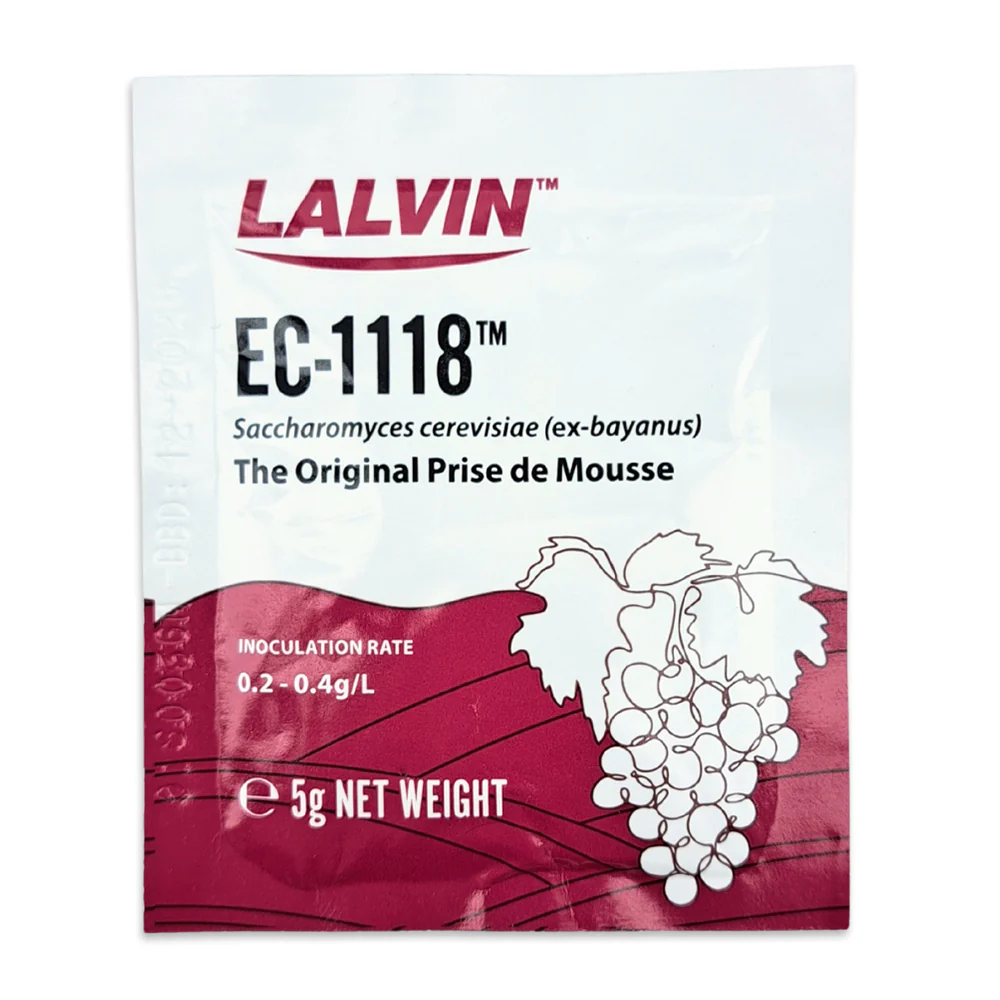
Lalvin - EC-1118 Yeast x 5g (Champagne / Cider Yeast)
Lalvin EC-1118 is the original ‘prise de mousse’. It was isolated in Champagne and its use is validated by the Comité Interprofessionnel du Vin de Champagne (CIVC).
Its strong competitive character, its ability to ferment at low temperature, good flocculation and excellent alcohol tolerance, make Lalvin EC-1118 an excellent strain to be used in a wide range of applications (such as sparkling wines, fruit wines and ciders).
Dosage
White, red and rosé winemaking: 25 to 40 g/hl
Secondary bottle fermentation: 50 g/hl
To restart stuck fermentation: 40 g/hl
Note: dosage range is based on the must sugar content and sanitary state of the grapes and winery.
How to Use
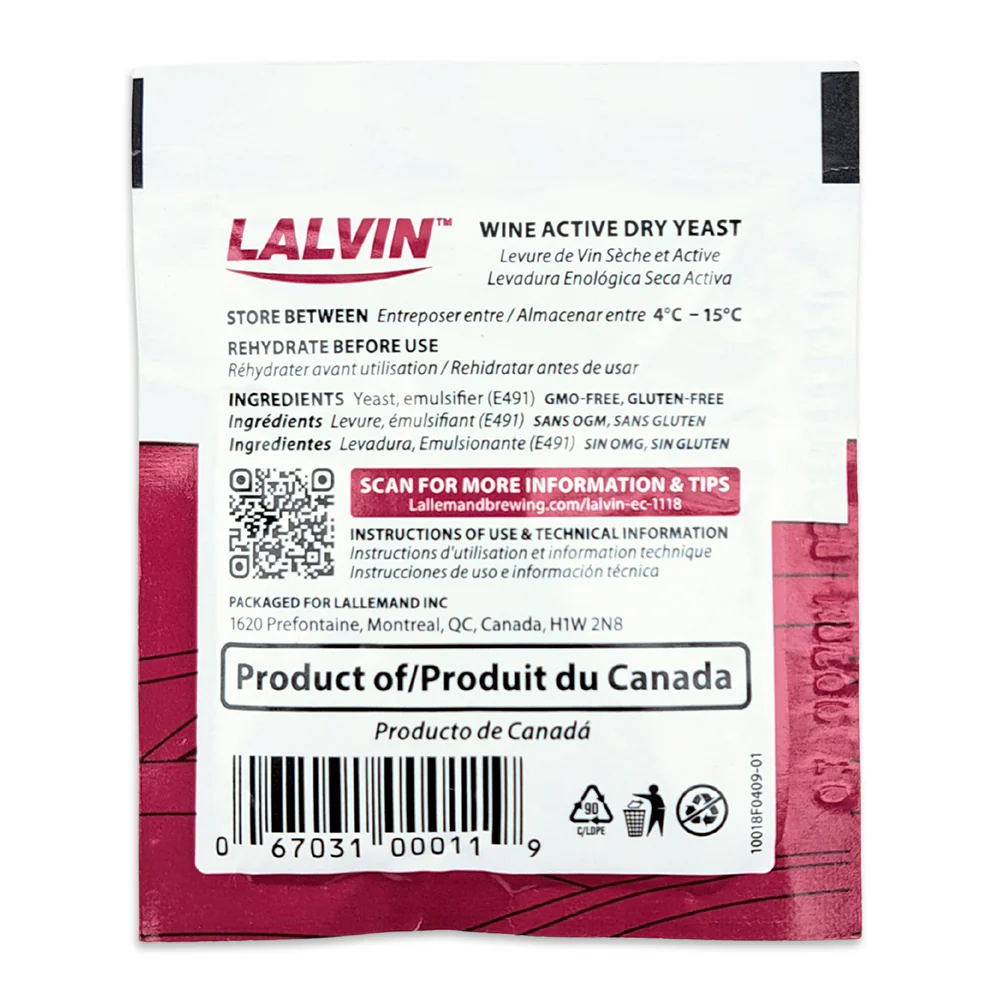
Rehydrate Lalvin EC-1118 in 5 times its weight of potable water at 40°C. Let stand for at least 20 minutes then gently stir occasionally to break up any clumps. Add to the must.
Notes:
– The total rehydration duration should never exceed 45 minutes
– Avoid cold shocking the yeast. the temperature drop between the must to be inoculated and the rehydration medium should never be above 10°c (in case of doubt, please contact your supplier or Lallemand)
– It is essential to rehydrate the yeast in a clean container.
– Initial rehydration in must is not advisable.
Microbiological & Oenological Properties
Saccharomyces cerevisiae bayanus
Competitive factor
High alcohol tolerance up to 18%
Short lag phase
Fast fermentation rate in a wide pH range
Wide range of temperatures for fermentation including low temperatures (Optimal between 15°C to 25°C)
Low requirement in assimilable nitrogen
Low O2 requirement (especially at low temperature)
Low to average production of volatile acidity
Average SO2 production
Low H2S production
Low foam formation
Details & Craftsmanship
Every detail has been carefully considered to bring you the perfect product.
Description
Technical Data Sheet - Lalvin EC-1118
Robust, Reliable and Neutral. Useful for a wide range of applications, including wine and fruit cider fermentations.
Lalvin - EC-1118 Yeast x 5g (Champagne / Cider Yeast)
Lalvin EC-1118 is the original ‘prise de mousse’. It was isolated in Champagne and its use is validated by the Comité Interprofessionnel du Vin de Champagne (CIVC).
Its strong competitive character, its ability to ferment at low temperature, good flocculation and excellent alcohol tolerance, make Lalvin EC-1118 an excellent strain to be used in a wide range of applications (such as sparkling wines, fruit wines and ciders).
Dosage
White, red and rosé winemaking: 25 to 40 g/hl
Secondary bottle fermentation: 50 g/hl
To restart stuck fermentation: 40 g/hl
Note: dosage range is based on the must sugar content and sanitary state of the grapes and winery.
How to Use
Rehydrate Lalvin EC-1118 in 5 times its weight of potable water at 40°C. Let stand for at least 20 minutes then gently stir occasionally to break up any clumps. Add to the must.
Notes:
– The total rehydration duration should never exceed 45 minutes
– Avoid cold shocking the yeast. the temperature drop between the must to be inoculated and the rehydration medium should never be above 10°c (in case of doubt, please contact your supplier or Lallemand)
– It is essential to rehydrate the yeast in a clean container.
– Initial rehydration in must is not advisable.
Microbiological & Oenological Properties
Saccharomyces cerevisiae bayanus
Competitive factor
High alcohol tolerance up to 18%
Short lag phase
Fast fermentation rate in a wide pH range
Wide range of temperatures for fermentation including low temperatures (Optimal between 15°C to 25°C)
Low requirement in assimilable nitrogen
Low O2 requirement (especially at low temperature)
Low to average production of volatile acidity
Average SO2 production
Low H2S production
Low foam formation